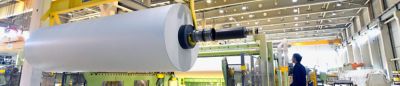
Paper and board inspection: Stable quality, efficient production

Paper and board manufacturers must run fast and wide webs while meeting tight surface quality requirements. In practice, even small defects can escalate into web breaks, waste, and rejected rolls - increasing downtime and putting profitability at risk.
That’s why inspection needs to deliver more than detection. Advanced surface inspection, combined with web break monitoring and production analytics, creates the data basis to detect and classify defects, and act early.
This creates the data foundation for stable quality across grades, fewer break-related losses, and higher throughput.

Detect and classify defects for consistent surface quality

Stabilize production through early, actionable insights

Reduce web breaks and unplanned downtime

Transparent roll quality for confident release decisions
Web break monitoring: Cut downtime. Stabilize production.
Web breaks are one of the most critical efficiency risks in paper and board production. Unplanned breaks stop production, create material losses, and drive significant downtime - directly impacting throughput and OEE.
Without web break monitoring, break events remain hard to trace back to their root causes (e.g., holes, edge cracks, coating defects, formation issues).
Result: Breaks occur unexpectedly — and losses repeat.
Web break monitoring captures and analyzes break events in real time—including the moments before the break - so teams can identify patterns, validate root causes, and act faster.
Result: Reduced downtime, more stable production, and fewer recurring break-related losses across grades.
Benefits:
- Fewer machine stops and reduced downtime
- Actionable insights for downtime and web break events
- Higher machine availability and improved production efficiency
Defect detection for paper and board
Web break monitoring helps teams trace break events back to their causes and act faster. Defect detection closes the loop by identifying the defects that trigger breaks, downstream issues, and unnecessary rejects - before losses repeat.
In paper and board production, not every defect has the same impact on quality or process stability. Effective defect detection focuses on the defects that matter most - especially those that can lead to web breaks, downstream problems, or roll rejection.
Benefits:
- Reliable defect detection for high surface quality
- Early detection of critical defects
- Fewer rejected rolls and less rework
Informed quality decisions through intelligent classification
Machine-learning based classification uses richer defect information - enabled by advanced illumination, multi-scan imaging, and HDR - to improve defect differentiation across all grades.
Result: More consistent classification and stable quality decisions. This is where advanced imaging delivers measurable value.
 Delamination
 Streak
 Hole
Hole
 Wrinkle
 Tear
Tear
 Insect

Machine Vision Insights
Higher classification accuracy. Lower inspection cost.
Instead of adding separate camera banks per optical setup, the system combines multiple illumination channels and advanced imaging modes within one multi-line line scan architecture. This improves defect differentiation while reducing hardware, footprint, and integration effort.
This means:
- Full machine-direction resolution maintained (100% web coverage)
- More reliable defect differentiation for stable classification
- Fewer camera banks → lower integration effort and cost
Multiple optical setups with one camera bank
The illustration on the left side shows a conventional setup using two cameras / camera channels for different inspection angles.
COMBI mode on the right side replaces this with one multi-line line scan camera and alternating illumination channels. Full downweb resolution and 100% coverage in machine direction are maintained.
Result: Reduced hardware, lower investment, smaller footprint.

Advanced imaging modes for maximum defect differentiation
The vertical and angled light beams (α) capture different surface and structural characteristics of the web.
HDR captures multiple exposure levels of the same line.
TDI increases light sensitivity by accumulating signal across sensor lines.
Result: More defect-relevant information for accurate and stable classification.

Enable efficient roll handling and quality decisions
Efficient roll handling and quality decisions are critical for doctoring, slitting, and downstream finishing processes. Uncertainty about defect relevance often leads to conservative roll downgrading, unnecessary rework, or delayed release decisions.

By combining position-accurate defect data with a clear assessment of defect relevance, inspection systems enable quality managers at paper mills to evaluate rolls objectively. This provides a reliable basis for targeted doctoring, transparent roll grading, and confident release decisions across all paper and board grades.
Benefits:
- Position-exact defect data for finishing
- Automated roll classification and evaluation
- Reduced pulping and rework
Laser defect marking for downstream finishing
Contamination-free laser defect marking enables precise, automated, ink-free marks directly on the paper/board web. As a non-contact solution, it ensures reliable defect localization and tracking for doctoring, slitting, rewinding, and downstream finishing—without affecting surface quality.

- Ink-free marking - no surface contamination
- Precise defect position at full production speed
- Easy integration into converting lines (doctoring, slitting, rewinder)
Solutions for different paper and board grades
Inspection requirements vary by grade. A solution that performs on coated graphical paper may miss structural defects in packaging board - and vice versa. That’s why paper and board inspection must be grade-specific: tuned to surface properties, defect types, and line speed to protect roll yield, and downstream quality.
High surface quality is critical for coated and uncoated graphical papers. Even minor visual defects can affect coating, printing, and finishing quality, leading to customer complaints or rejected rolls.
Challenges:
- High sensitivity to visual surface defects
- Defects that can trigger web breaks during long, fast runs
- Precise defect localization required for downstream processes
How inspection supports production:
- Detects coating-related defects (e.g., pinholes, streaks, coating defects) and formation-related issues
- Flags break-critical defects early to reduce break risk and unplanned downtime
- Provides position-accurate defect data for doctoring / finishing decisions
You achieve: consistent visual quality, fewer rejected rolls, and more stable high-speed production.
Board and liner

Packaging board and liner must deliver strength, robustness, and converting performance. Many critical defects are not “pretty vs. ugly” - they are strength- or process-critical and show up later in converting or at the customer.
Challenges:
- High-speed production with minimal tolerance for downtime
- Break- and strength-critical defects (e.g., holes, edge cracks, impurities)
- Reliable roll grading required for objective release decisions
How inspection supports production:
- Reliable detection of structural and surface-critical defects at full production speed
- Early identification of defects that compromise board strength
- Transparent defect data for objective roll grading and release decisions
You achieve: maximum output, reduced waste and consistent board strength
Media hub
- Case Study
- Webcast
- Technical paper
Data-driven quality and process monitoring
Integrating inspection, break monitoring, and analytics creates actionable insights for process optimization.
Production analytics for paper and board
Real-time dashboards and trend analysis allow mills to continuously improve process stability and product quality.
Benefits:
- Transparent KPIs and defect trends
- Root-cause analysis for breaks and defects
- Continuous quality and efficiency improvement
Service solutions and individual trainings


For the efficient and future-proof operation of your production systems our highly qualified service teams support you globally in all matters. We provide the implementation, maintenance and servicing as well as the analysis and optimization of your systems.
Enhance system performance, ensure compliance, and reduce downtime. Based on modular programs, our expert trainers provide the hands-on experience your team needs for sustainable operational success.